 Login »
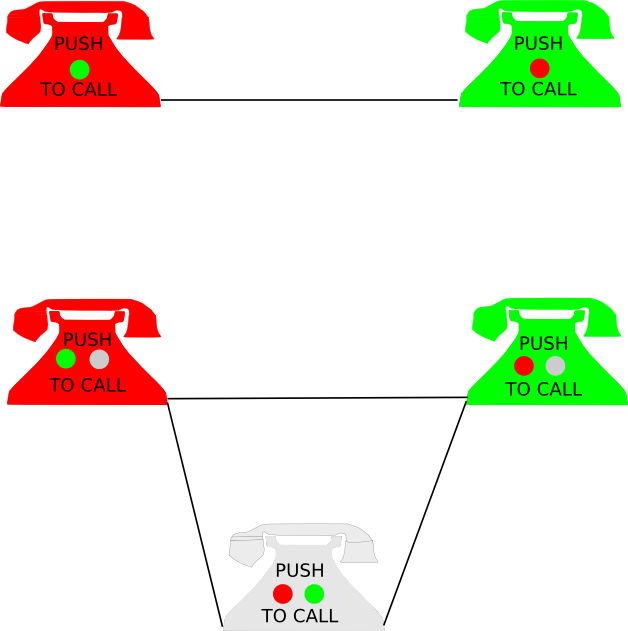
In the beginning telephone exchanges (the equipment which routes and connects calls) did not exist. Early phones were wired directly to each other, often with some sort of call button to ring the bell at the distant end.
This is fine for just two phones, but as the number of phones you want to call increases, the number of wires becomes impractical. You also need some method of identifying each phone and connecting to just that one. For a small number of phones (up to about 10) this might be done with buttons or switches — a bit like an intercom on the front door of a block of flats. Beyond a handful of phones, this method gets impractical too, and a much better approach is to give each phone a number and have a central machine connect you to the number you want.
This is the purpose of the telephone exchange, or telephone switch as it's often called. The process of connecting the call is often called switching, because it switches the connection from your phone to any number of other phones.
Switching has evolved over the years from manual switchboards, where a person in the exchange made the connection for you, through several kinds of automatic switching, to today's exchanges — digital solid-state switches controlled by computers. Some calls are now also carried by packet-switching systems alongside computer data. Here we look at how the technology evolved from the 1870s to the present day. Packet switching itself is described in more detail in the Packet Switching & Internet section.