 Login »
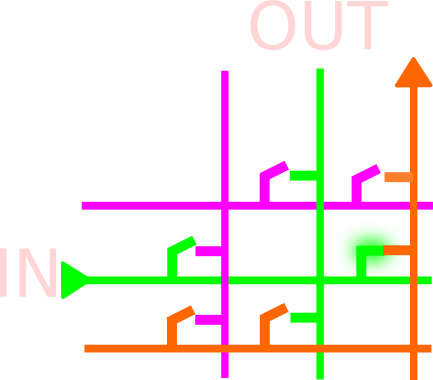
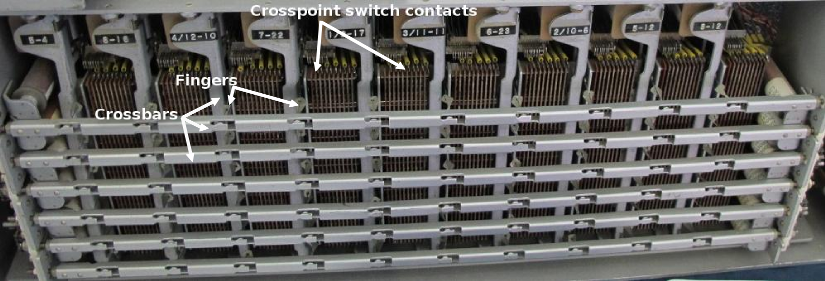
In the 1950s and '60s, a lot of countries started replacing Strowger exchanges with Crossbar. Crossbar is still electromechanical, but more compact when handling large numbers of lines. It's a common-control system, using a matrix of lines arranged as a grid; an electromechanical switch mechanism — the crossbar itself — operates contacts at the intersection of two lines to connect them, under instruction from the common control.
The first crossbar exchange in the UK opened in 1964 at Broughton, near Preston — an AT&E 5005 system, chosen as a field trial partly for its proximity to AT&E's Liverpool factory (by then part of Plessey), so engineers could easily monitor it and demonstrate it to overseas customers.
At this point the Post Office wasn't keen on adopting Crossbar nationwide, preferring to stay with Strowger until a viable electronic system could be developed. Plessey, though, could see its Strowger export orders diminishing as overseas customers switched to Crossbar, and had developed the 5005 to meet that demand.
The development of electronic switching took longer than expected, as explained in more detail in the Electronic Switching section, so from 1968 the Post Office began installing Crossbar nationwide.
Plessey (and the other Strowger manufacturers, GEC & STC) wanted to wind down Strowger production, and had been pushing the Post Office to adopt Crossbar. A deal let GEC license Plessey's 5005 design, manufacturing and supplying it in competition — the Post Office insisted on a choice of suppliers. From 1973, STC supplied its own crossbar system too.
The last Crossbar exchange in the UK, at Droitwich, was removed from service in March 1994.