 Login »
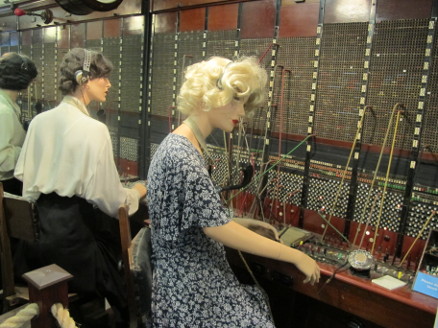
Early telephone switches were manual. A human operator answered you, asked which number you wanted, and made the connection by plugging in physically. Manual switchboards appeared very quickly after the telephone's introduction — the first exchange in the UK was at 36 Coleman Street, London.
Just like the buttons on the first phones, though, beyond a few thousand phones, having them all connected to one switchboard becomes impractical — to say nothing of distance, since phone lines only work over a few miles at most. So exchanges became necessary in each town, with calls further afield connected exchange-to-exchange using special lines called "trunks" and "junctions." A call over a long distance might pass through several exchanges en route, much like changing trains on a long journey.
Manual exchanges worked well in the early years, but as the number of users and calls grew, the system's limits showed. Operators were limited in how fast they could connect calls, particularly long-distance ones passed along a chain of operators. Even for local calls, as lines and call volume increased, there could be a delay of several seconds between lifting the handset and the operator answering. Monitoring a busy switchboard, connecting calls, passing calls to the next exchange, and tracking the end of a call for billing was a heavy workload — big exchanges needed many operators.