 Login »
Strowger exchanges had no common control — no central system overseeing the switching of calls. Each selector worked independently, step by step: a form of distributed control.
This made Strowger exchanges very reliable, since (apart from the Ringing Machine and power supply) a single failure meant only a partial loss of service — reduced capacity, not a total outage. The disadvantage was that routing logic was spread throughout the exchange, making changes harder, especially in complex networks with lots of big exchanges connected directly together, as in big cities.
Common control exchanges solved this with a central system that decides a path through the exchange, then operates the switches accordingly. An early common control system was the Director, devised by Automatic Telephone & Electric (AT&E) in Liverpool in the 1920s.
AT&E held a licence from Strowger's US company to manufacture Strowger equipment in the UK at its Edge Lane factory, and by the 1920s had already supplied several step-by-step Strowger systems to the Post Office, which was testing various forms of automatic switching. The Post Office felt Strowger's lack of common control made it unsuitable for complex networks in London and other big cities, and instead wanted a different system called Panel Switching. In the wake of the Depression and General Strike of the late '20s, AT&E convinced the Post Office that Whitehall would never allow it to buy a system not manufactured in the UK.
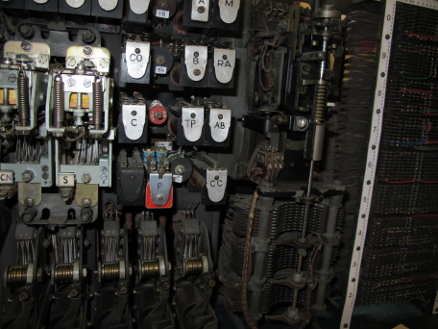
AT&E engineers devised a common-control system for Strowger called the Director — essentially an electromechanical computer — and the first Director-controlled Strowger exchange opened in Holborn in 1927. It kept enough distributed control to retain Strowger's reliability, but made routing changes much easier and quicker as the network grew.
One side effect can still be seen today: cities that used Director exchanges (London, Birmingham, Liverpool, Glasgow & Edinburgh) still have three-digit exchange codes and four-figure customer numbers. The Director identified the exchange using three digits and could store four more in memory. The number dialled went into a Director, which worked out the route through the two-motion selectors and sent out pulses to operate them — so the route could change without altering the phone number.