 Login »
What happens when you lift the handset?
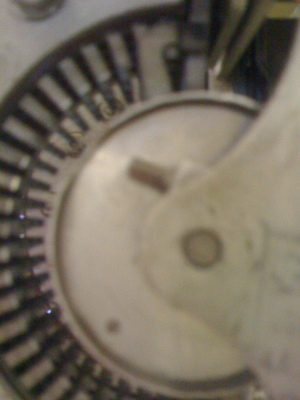
A customer's line is controlled by its Line Circuit — two relays and a uniselector. The uniselector is a semi-circular arc of contacts (typically 24) with a set of wipers that rotate around the arc to make contact with any of the 24 outlets.
The wipers are metal arms carrying the incoming line. When someone lifts the handset, the line circuit relays detect this and operate the uniselector, which hunts around its 24 outlets looking for one that's free. Each outlet leads to a 2-motion selector.
A line needs to be connected to a 2-motion selector before dialling can begin, since the 2-motion selector is the basic building block that processes the dialled digits.
Lines could, in theory, be wired directly to their own 2-motion selector, but this would be wasteful, since most lines are idle most of the time. 2-motion selectors are complex, costly pieces of kit, so there are only enough to handle the anticipated number of simultaneous calls — it's the job of the line circuit and uniselector to find a free one whenever a call is made.