 Login »
The telephone goes public
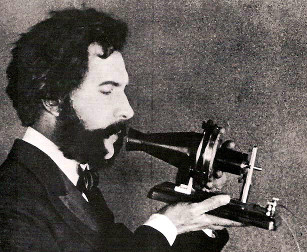
The working telephone of 1876 coincided with an exhibition called the Centennial Exposition in Philadelphia, and Bell decided to make an exhibit there. Watson constructed show-piece quality versions of each of the prototypes made up to that point and gave the phone its first public showing.
On 9th October the first "long distance" call was made between Boston and Cambridge, MA — a distance of about 2 miles. At the first try no sound came through, but then Watson had a thought: although he had disconnected the telegraph from the wire line they were using, could it be that there was another telegraph instrument somewhere else in the building? He traced the wires from the point where they entered the building and, sure enough, found a relay with a high resistance coil in the circuit. He cut it out, and rushed back to try again. Clear as a bell came through Bell's "Ahoy". Watson "Ahoyed" back, and the first real-distance call was made.
The following morning the Advertiser newspaper fawned over the latest scientific invention, and the phone's rise to fame had begun. People from all over the world started to make pilgrimages to Bell's lab to hear the telephone talk. Watson's account of the events describes two regular visitors, two young Japanese men, "very polite, quiet, bright eyed, who saw everything and made cryptic notes. They took huge delight in proving that the telephone could talk in Japanese."
Payoff
Despite the success of the phone, Bell's financial problems had not subsided. The Western Union Telegraph company had refused to purchase Bell's patents for $100,000. Two years later, Western Union would have gladly paid $25,000,000, according to Watson. In the meantime, before the royalties and licensing money started to roll in, Bell found an alternative source of income via his invention. There was such intense interest in this new invention that thousands of people were prepared to pay to listen to Bell give lectures on the telephone and demonstrate its use. For these demonstrations Bell would be in the lecture theatre, often with an audience of 2000 or more. Watson would be located about 20 miles away on the other end of the telegraph line.
Bell would give the requisite background and theory, and then came the entertainment. Watson would remotely address the crowd with phrases such as "Good evening, how do you do? What do you think of the telephone?" which they could all hear, then Watson would burst into song with tunes such as 'Hold the Fort', 'Yankee Doodle' and, as a nod to the Professor's nationality, 'Auld Lang Syne'. The finale, 'Do Not Trust Him, Gentle Lady', always brought down the house.
The Watson Buzzer
Up to this point, the speaker and microphone, although referred to as a 'telephone' when combined together, lacked something rather essential. In Watson's words: "it began to dawn on us that people getting their living in the ordinary walks of life couldn't be expected to keep the telephone up to their ear all the time waiting for a call." So Watson set to, to invent some sort of calling signal. Watson's boss, the owner of the workshop where the development work had been done, had come up with his own method on his phone: thumping the diaphragm with the end of a pencil, which created a banging noise at the receiver. It worked, so long as the called party wasn't too far away, but it damaged the diaphragm, and Watson decided it wasn't really practical for the general public. "Besides, we might have to supply a pencil with every phone," Watson feared, "and that would be expensive."
The first solution was a hammer inside the unit, operated by a lever on the outside. When the lever was operated, the hammer hit the diaphragm at a point where it could do no damage. It was an improvement, but the public wanted something better.
Watson devised a magneto call bell — giving rise to magneto type telephones often seen in films where the caller lifts the handset then frantically winds a handle to generate the calling signal.
Competition
By now Western Union had decided that the telephone wasn't the little toy they originally thought it was, and wanted in on the action. After discovering Bell & Watson's original $100,000 offer was no longer on the table, they decided to help themselves. They enlisted Thomas Edison to evolve for them his carbon based transmitter, which gave much better sound reproduction without so much shouting required — although it clearly came under Bell's original patent of 1875. The tiny Bell Company sued the huge goliath of Western Union, and Watson had to devote considerable energy to defending their design and proving their creation by making reproductions of each of their early prototypes.